How to Become a YouTuber in 2026: A Beginner’s Roadmap to Success
Ready to launch your YouTube career? This 2026 roadmap covers everything from the "Proof of Human" algorithm to AI-powered editing and modern monetization.
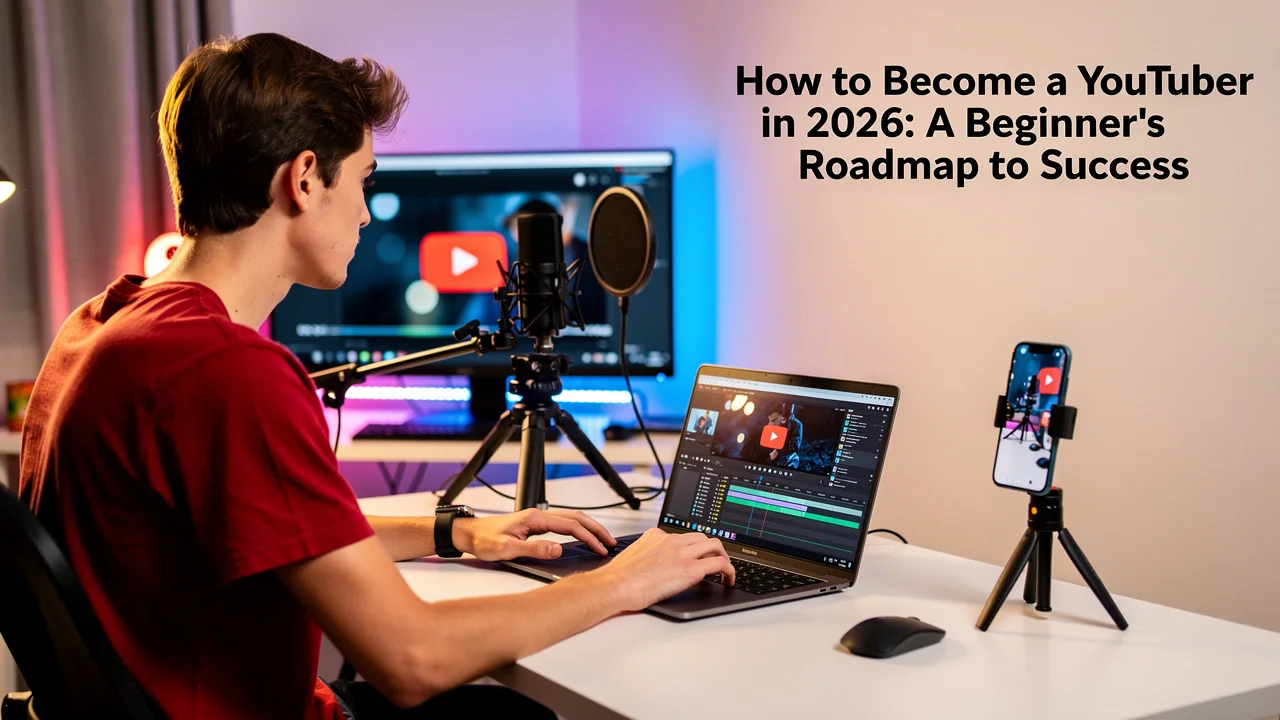
Guide to Become a YouTuber in 2026
The digital landscape of 2026 is a far cry from the early days of "broadcast yourself." Today, YouTube is a multi-layered ecosystem where artificial intelligence, hyper-niche communities, and a "Proof of Human" philosophy dictate who rises to the top. The creator economy has matured into a $250 billion industry, and while the competition is fierce, the tools available to beginners have never been more powerful.
If you are starting your journey today, you aren't just a video maker; you are a digital entrepreneur. This 2,000-word guide serves as your comprehensive blueprint for navigating the complexities of YouTube in 2026.
Phase 1: Strategic Positioning in the AI Era
In 2026, the most significant challenge for new creators isn't other humans—it’s the flood of AI-generated "slop." To survive, you must lean into what a machine cannot replicate: authentic human experience.
1. Finding Your "Content Moat"
A "Content Moat" is a unique advantage that protects your brand from being easily copied. In the past, people chose niches like "Cooking" or "Gaming." In 2026, those are too broad. You need to find the intersection of three distinct pillars:
- A Hard Skill: Something you can do (e.g., coding, woodworking, urban gardening).
- A Personality Trait: How you do it (e.g., high-energy, deadpan humor, minimalist/calm).
- A Unique Perspective: What you believe (e.g., "Tech should be repairable," or "Cooking should take less than 10 minutes").
Action Step: Create a Venn diagram of these three pillars. The center is your niche. This ensures that even if an AI can generate a video about your topic, it cannot replicate your specific blend of expertise and personality.
2. The Multi-Format Ecosystem
Gone are the days of being "just a long-form creator." In 2026, YouTube rewards those who utilize the platform’s full feature set.
- YouTube Shorts (The Discovery Engine): These are your "handshakes." They introduce you to new viewers. Aim for 3–5 Shorts a week to feed the top of your funnel.
- Long-Form Video (The Relationship Builder): This is where your community is built. These videos (10–20 minutes) provide the depth required to turn a casual viewer into a loyal subscriber.
- Live Streams (The Trust Signal): Live content is the ultimate "Proof of Human." Streaming once a week builds a level of intimacy that edited videos cannot match.
Phase 2: The 2026 Tech Stack
You don't need a Hollywood budget, but you do need to be smart about your gear. The "aesthetic" of 2026 has shifted away from over-produced, glossy studio looks toward "Polished Authenticity."
1. Hardware Essentials
- The Smartphone Supremacy: By 2026, mobile sensors have reached a point where a flagship phone (iPhone 17 or equivalent) is more than enough for 4K cinematic footage. Focus on lighting rather than buying a new camera.
- Audio is 70% of Video: Viewers will tolerate grainy video, but they will click away instantly from "tinny" or echoed audio. Invest in a USB-C Wireless Lavalier Mic for mobility or a Dynamic Broadcast Mic for desk setups.
- Lighting for Depth: Avoid flat lighting. Use a "Three-Point Lighting" setup (Key, Fill, and Backlight) to create a sense of three-dimensional space, which helps your video stand out on small mobile screens.
2. The AI-Augmented Workflow
In 2026, successful creators don't fight AI; they use it to handle the "drudge work."
- Research & Ideation: Use YouTube’s integrated "Inspiration" tools to analyze what your target audience is searching for but not finding.
- Editing & B-Roll: Tools like Descript or Runway allow you to edit by deleting text and generate high-quality B-roll when you don't have the footage you need.
- Global Reach (Auto-Dubbing): One of the biggest shifts in 2026 is the ease of going global. Use YouTube’s multi-language audio tracks to reach Spanish, Hindi, or Portuguese-speaking audiences without re-filming.
Phase 3: Mastering the Algorithm (The Viewer-Centric Approach)
The YouTube algorithm in 2026 is no longer a mystery of "tags" and "keywords." It is a highly advanced neural network that predicts satisfaction.
1. The Trinity of Metadata
- The Thumbnail (The Visual Hook): Your thumbnail should tell a story in one second. In 2026, high-saturation, "shock face" thumbnails are declining. The trend is toward "High-Context Minimalism"—clear, high-quality images that promise a specific emotional payoff.
- The Title (The Curiosity Gap): Your title should complement, not repeat, the thumbnail. Use "The Curiosity Gap"—give them enough info to be interested, but not enough to satisfy them without clicking.
- The First 30 Seconds (The Retention Hook): You have exactly 5 seconds to grab attention and 25 seconds to justify it. Start with a "Cold Open" that shows the most exciting part of the video, then transition into your intro.
2. Understanding "Satisfaction Metrics"
YouTube now looks beyond "Watch Time." It measures:
- Returning Viewers: Do people come back for your next video?
- Survey Data: YouTube frequently asks viewers "Was this video worth your time?"
- The "Share" Factor: Does your content spark a conversation?
Phase 4: Content Strategy & Scripting
Content in 2026 must be "Search-First, Community-Led."
1. The Value-Per-Minute Ratio
Attention spans have bifurcated. People either want 15-second bursts or 3-hour deep dives. If you are in the middle (10–15 minutes), your "Value-Per-Minute" must be high.
- Trim the Fat: If a sentence doesn't move the story forward or provide a laugh, delete it.
- Pattern Interrupts: Every 90 seconds, change something. A zoom-in, a text pop-up, a sound effect, or a change in background. This resets the viewer's attention span.
2. Storytelling Frameworks
Even a "How-to" video is a story. Use the Hero’s Journey for your tutorials:
- The Problem: The "Villain" your viewer is facing.
- The Struggle: Why other solutions didn't work.
- The Discovery: Your unique tip or method.
- The Transformation: The result of using your method.
Phase 5: Sustainable Monetization
In 2026, waiting for AdSense is a beginner's mistake. You should view AdSense as a "bonus," not your primary income.
1. Vertical Integration (The Brand Model)
Modern YouTubers are becoming "Direct-to-Consumer" brands.
- YouTube Shopping: Tag your own merchandise or affiliate products directly in the video. In 2026, viewers can click a product and buy it via Apple Pay or Google Pay without pausing the video.
- Memberships & Micro-Transactions: Use "Super Thanks" and "Channel Memberships" to offer exclusive perks like behind-the-scenes footage, Discord access, or early releases.
2. The Portfolio Income Strategy
- Affiliate Marketing: High-ticket affiliates in your niche.
- Sponsorships: Negotiating with brands not just for a "shoutout," but for a long-term partnership.
- Digital Products: Courses, eBooks, or presets that solve a specific problem for your audience.
Phase 6: Managing Growth and Burnout
The biggest reason YouTubers fail in 2026 isn't the algorithm—it’s burnout.
1. The "Batching" Workflow
Do not film, edit, and upload in one day.
- Day 1: Scripting and Research (3–5 videos).
- Day 2: Filming Day (The "Heavy Lift").
- Day 3–4: Editing and Packaging.
- Day 5: Community Engagement and Analytics Review.
2. Building a Community, Not Just an Audience
An audience watches; a community participates.
- Use the Community Tab daily. Polls, behind-the-scenes photos, and text updates keep your channel alive in the feed even when you aren't posting videos.
- Reply to the first 50 comments. The first hour after an upload is the "Golden Hour" for engagement.
Phase 7: The "Proof of Human" Checklist
Before you hit "Publish" in 2026, ask yourself these four questions:
- Could an AI have written this script? (If yes, add a personal anecdote).
- Does the thumbnail look like a stock photo? (If yes, add a unique human element).
- Is there a clear "Call to Action"? (Tell them exactly what to do next).
- Would I watch this if I didn't know the creator? (The ultimate honesty test).
Conclusion: The Long Game
Success on YouTube in 2026 is a marathon, not a sprint. The "overnight success" stories you see are usually the result of years of invisible work. Focus on 1% improvement every video. Better lighting this week, a tighter script next week, a more compelling thumbnail the week after.
By the time you reach your 100th video, you won't just have a channel; you'll have a career.
Ready to create better thumbnails?
Start generating click-worthy thumbnails with AI today.
Get Started Free